Labels

Showing posts with label creative commons. Show all posts

Thursday, May 19, 2016

On your bike {musical notes}

The riff in On your bike is another incarnation of one of the musical themes across Setsu, where this or a similar ascending 3-chord riff is heard on Harvest and Practice Perfect (in an E7-chord shape, rather than the A7-chord formation above); but the riff appears even more similarly on the June track (coming up), except in a minor-key guise.

Here, in On your bike, you've got the capo on the third fret. The chords look like this:


With alternate parts snazzy finger-picking and chunky strumming.

Lyrically, the verses focus on three different characters. The junior high school boy:
I get up on a Monday: gotta get off to school
Got my books in my bag, got a black and white uniform
Don't need my jacket now the May days aren't so cool
Shit! 母さん 7.23 ともゆき君's gonna be waiting there for me [母さん = kaa-san = mum; ともゆき君 = Tomoyuki-kun = his friend Tomoyuki]
Where we meet every day at the convenience store car park
Gotta get to pre-school baseball at the school park
Out the door, saddle up, helmet on, but don't do the strap up
It's only compulsory to wear your helmet till you finish junior high, so not doing the strap up is about as open as rebelliousness gets for these kids. Then there's the OL (office lady) with dreams of not being an OL for much longer:
I get up every weekday: gotta get off to work
Hair up, face on, blue office lady uniform
3 years now as a desk clerk
ね—母さん 8.24. No time for breakfast. Out the door
At my desk I dream: me as a bride
But for now I'll saddle up and ride
And the elderly farmer, still working the family plot:
The sun's up, so so am I at 5
The field needs me to bend my back
That's how my crops and I continue to thrive
So saddle up for a wobbly ride again
Not bad for an octogenarian
I am free
Which is exactly why he or she is still so fit at that age. (I was pretty happy getting the word octogenarian into a song, by the way :) ).  They do get up ridiculously early. No daylight savings means the sun is up around five in the middle of Summer.

For each I tried to give the sense that, despite being trapped in their role in society, their daily bike ride is a kind of freedom, however small, not like the rest of us mugs in our cars crammed on Japanese roads.

Finally, this is one of the best middle eights (or bridges if you prefer) I've written, complete with diminished chords. Here's the sequence with the vocals turned down so as to focus on the dreamy guitar effect:


Thursday, May 5, 2016

Shakuhachi man {musical notes}


Ok, some musical notes to accompany my first post about the ideas behind the song that opens the Setsu album.

Musically, the song evolved out of the guitar riff/chords that you hear in this final version only in the opening and final verses. This bit:


It's an open A-chord for two bars followed by a bar each of G and D chords that keep the C-sharp third note front-and-centre. Given that these are all open chords I came up with a hammer-on, finger-picking style that lent a jaunty air to the whole thing, enhanced by the rising vocal melody that evolved over the top of the chord sequence. (Actually the delivery of the vocal line changed a bit during recording as my voice kept cracking on the top notes of the quiet verses. That's why the sultry intro vocal is an octave lower than the rest.)

I can't recall where the idea came to insert a shakuhachi-playing-monk-cum-modern-day-spy in the lyrics. But obviously that called for some real shakuhachi in the tune. I say 'real' but this is a sample bent beyond all recognition of a traditional rendition. I tried to incorporate the breathy sounds that are a feature of good shakuhachi playing, both at the start and the end. The honkyoku played by these monks, as with pretty much any shakuhachi music, is hardly jaunty: rather it's haunting and melancholy. Hence the lines in the middle 8:
Shakuhachi in any other player's hands
Is melancholy
But I can't help but play this happy melody
I liked the idea that this guy had learned an instrument that was meant to be one thing but that he couldn't help but infuse it with his own cheery disposition. The melody here is far more Western and major-key than you would hear in a traditional piece. Hence, though we start out hauntingly, as the "morning spring wind sounds" in the second verse, we gradually build to the funky chunkiness and guitary goodness in the verse that follows and we head to the park with all the people and blue tarpaulins and eventually get some quite cheery shaku-playing in the remainder of the song.

Almost forgot: the middle section has alternating bars in 6/4 and 4/4 time, 6/4 being something I became somewhat obsessed with throughout this album. Not sure why. The chord sequence here is also in Temple Garden in the massively rockin' outro sequence. These bookend the album nicely, since the Skakuhachi Man turns up at the temple garden. You realise it's the same temple and garden in those two tracks, right?

6/4 (different chords) also appears in the title track, Setsu.

Finally a fun fact: the little taps you can hear right at the start underneath the opening verse are me tapping the back of the Mermaid Guitar in the garden and recorded on my phone. Not the most high-end recording device or sound-proof studio environment but it worked.

And finally, finally, Onomichi in Hiroshima Prefecture was the place I had in mind when writing this:
Sit beneath this lonely tree
High up on a hill, looking out over the sea
The town below me wakes from sleep
A ribbon of houses wedged beneath the mountains and the sea

A travelling shakuhachi man, I love this cherry tree right here
As I sit a morning Spring wind sounds
And from just above my head the first pink blossom flutters down
I come to this temple this time every year

Onomichi Shrine with Blossom

Friday, April 22, 2016

Shakuhachi man


There were these monks in feudal times - Komusō (こむそう) or 'monks of nothingness' - You can still occasionally see them around, begging for alms, as it were, about as passively as you could possibly beg. They just stand there with - yes - a basket on their heads. Sometimes (as pictured) they wear a basket on their heads AND play a shakuhachi.

In feudal times at least, the particular Fuke Zen Buddhist sect that these guys belonged to was keen on pilgrimages, apparently, so this was where I came up with the idea that a wandering musician could tie the 12 tracks of Setsu together nicely, as an observer of all the other 11 characters in the months/tunes. While the idea of the basket is to 'remove' ones ego, this also made them ideal candidates for acting as spies for the Shogunate, since they were granted the ability to cross feudal borders freely. Apparently no-one thought to be suspicious of the guy who kept hanging around WITH A BASKET ON HIS HEAD.

Next post: musical notes on Shakuhachi Man.

Tuesday, April 12, 2016

Temple Garden / Karesansui

Temple Garden | 枯れ山水 (かれさんすい) is the closing tune for the Setsu album, though not the last in my release schedule. It's set in March.

As an album closer it's a bit of an epic. Slow tempo, acoustic sections build towards a punchy, rockin' outro with epic multi-part harmonies, which subside into a final poignant denouement. Lyrically, I try to revisit the characters from the other months of the album: the salary man from Sestu, the schoolgirls from Cosuplay, the Yankee Girl from the track of the same name (from July - but also referenced in Practice Perfect as the girlfriend of the Potter's son). And it also references the Shakuhachi Man, about whom you'll hear more in a few days when I release the April track, the travelling pipe player who spies on us all.

Another 'watcher' is the character at the centre of this month's track, the おばあさん (o-baa-san) who rakes the garden in her local temple. Anyone who has lived in a community with one or more of these bastions of Japanese society knows their beady glare, making sure of what everyone in the neighbourhood is doing and that they're following the rules. As a foreigner, initially you find yourself resenting the blatant staring that you can be subjected to by these senior citizens but, if you actually engage with them, usually their face will light up and they can be the most generous-spirited people you're likely to meet.

Temple Garden is about an entirely fictional old lady but is a tribute to o-baa-sans, a salute to their power and their influence as the glue that knits Japanese society together.

Tuesday, March 15, 2016

Practice Perfect {musical notes}


Practice Perfect began life, in my early sketches, in straight 4-4 time. At some point it evolved into something quite different, verses comprising repeated sixteen-beat segments (two bars of 6 and one of 4 beats). In the end I settled on the final arrangement because I liked how it took you off guard, and had a metronomic quality, especially in the outro sequence. This seemed to fit in with the theme of the song, relentless dedication to one's art.

Here's an early version (without drums but including mistakes) in 4-4 time.


The effect is quite different.


This version also shows how I tend to work on early drafts: lay down a guitar guide track on the acoustic, layer over some other guitar parts (here including bass) and then do main and backing vocal tracks, often the backing parts sung along with the main part all the way through, just to see how it sounds. I seldom plan to use these other than in selected parts but this way you sometimes get unexpected delights. Mostly these are just single takes, improvised as the tape rolls.


Also of interest, to those paying close attention throughout the Setsu tracks, is this motif that appears in several tracks.


These chords are the main riff in the November track Harvest and appear in a minor key version in the upcoming June track about the rainy season. I have a feeling they're somewhere else but can't put my finger on it at the moment.

The lyrics also refer to other tracks (not published yet): the Shakuhachi man will make an appearance in the opening track coming in April and the son in this track has a Yankie Girl girlfriend, both of whom might be the subjects of the July track.


Friday, March 4, 2016

Bizen-yaki

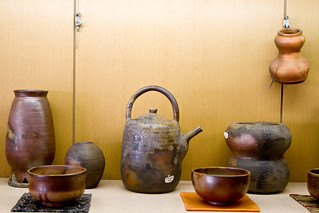
Once I was lucky enough to visit the house of a potter, one who made bizen-yaki. This was, in part, the inspiration for the story in Practice Perfect.

Brownness is it's main characteristic. But like many things that first seem plain to a foreigner in Japan -- what with our being used to gaudy brashness -- the subtlety of bizen-yaki grows on you after a while.
Bizen Ceramics

This potter had this massive kiln, something like this one:

enfu_6jizo_019

in which he could fire thousands of pots at a time. In fact, they only did two firings a year, as I recall -- quite an occasion apparently.

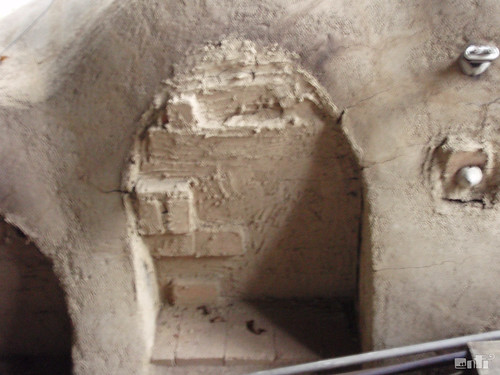
The ends were sealed off like this for the firing:

enfu_6jizo_030

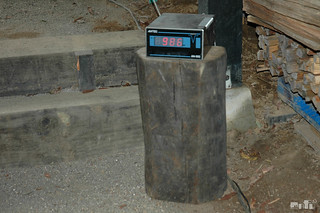
and it would be lit for days at a time, reaching an impressive temperature.

enfu_6jizo_003

Next post: musical notes on Practice Perfect.

Saturday, February 20, 2016

Practice Perfect


I arrived in Japan and made my inaugural speech to the 1200 kids in my high school. This was in English so I kept things simple: I play the guitar; I like soccer. That sort of thing. Next day, to my surprise, the captain of the soccer club approached me and asked if I would come along to practice.

I went to my first one, after school on a blisteringly hot August afternoon. We did various drills, passing, dribbling, etc. This went on for about an hour-and-a-half. I, having come from a Southern Hemisphere winter, was thankful for the Mugi-cha that was on offer to quench the thirst. I was pretty buggered, frankly, but thanked them for the run out. The captain said they were only stopping for a break. Ah, really? I stuck it out in the heat and was pretty glad when we finished. When is the next practice, I inquired? Tomorrow. Every day, in fact. Wow, I said, you guys must have some big games coming up. Nope, no games, we just practice.

I didn't make it back for another practice.
Practise by George Alexander Ishida Newman (CC BY)

This tune celebrates the Japanese love of the familiar, of dedication and of the value in skill and art for it's own sake. I chose a potter as the central character in this particular story but it could have been any number of things: kids' relentlessly practising baseball or kendo or whatever; musicians, calligraphers, flower arrangers. Common to many of these pastimes or art forms, perfection is never attainable but something to be pursued.

Here I framed the theme in the broader context of traditional arts and the fear that these will be lost. The father is worried that his son (who is an oblique reference to the yet-to-be-released July track) won't carry on the art. But the traditional arts and strong and the Japanese will find a way...

Next post: it's many shades of brown, it's pottery, it's the local pottery!

Wednesday, January 13, 2016

Under the Kotatsu (こたつのしたに)


There was this Japanese teacher at my school, Shibata-sensei -- an understated, intellectual man with a quiet power about him. He was in his fifties but he was in excellent shape. I heard that each day he got up at 5am, walked up the mountain behind his house to the temple up there, practised his karate and then meditated, presumably silhouetted against the rising sun behind him. He also ran the Kendo club. He was big on the very traditional Japanese arts but also very modern in his attitudes.

He invited me round to his place one winter's night and we were served an impressive series of dishes, followed up by warm sake. He was something of a philosopher, being a practising Buddhist, and liked to discuss customs and beliefs in our respective countries. This particular night we were sitting under the kotatsu, that is a table with a quilt sitting underneath the table-top that you drape over your legs; underneath there is a little heater that creates a toasty-warm oven for your lower regions. It's, as far as I know, only in Japan that these are used. (In part this is simply a cheap solution to flimsy old-style Japanese houses with about as much insulation as a cardboard box.)
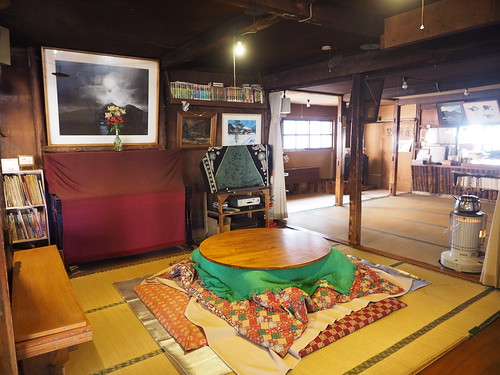
Kotatsu, Kuroyuri Hut Anyway, as we drank our sake he told us how he loved the Kotastu, for "the legs are warm but the head is clear." Classic Shibata.  The phrase always stuck with me and formed the basis for this song.

From the chorus (using the Roman alphabet):

Ashi ga atatakai, atatakai ga [My legs are warm, they're warm but]
Atama o sukkiri sasete kuru [my head is clear]
Boku wa ureshii, ureshii [I am happy, happy]
Kotastu no shita ni [under the kotatsu]

Saturday, January 9, 2016

Cosuplay musical notes

Cosuplay was the last tune to be completed for the Setsu album. It was quite a struggle to get the parts to fit together but, in the end, it's one of the tunes I'm most pleased with. For a while I wasn't sure if the juxtaposition between dark verse and poppy chorus worked: the verses alternate bars of B major then C major and the chorus shifts to a good old-fashioned doo-wop kind of thing with a G / E minor / A minor / C, though that does have an unexpected Gmaj7 thrown in on the word 'Geek'. Anyway, it was meant to sound both conformist and subversive to mimic the way the girls follow the rules all week and cosuplay on Sunday. Of course, this in itself is typical of Japanese subversion: it should still be done according to a strict schedule and within clearly-defined rules.

The dream sequence in the middle section, where the girls imagine leaving their "small town shopping mall" behind for the crowds and glamour of Harajuku, shifts unexpectedly from the neat resolution of the C at the end of the chorus up a semi-tone to a D flat minor. Again, this subversion of the doo-woppishness represents the rebelliousness of the thought of hanging out with 'actual' weirdos (what would grandma think!). To me at least, the girls in this tune won't realise this dream; the thrill is just in the thinking of it. Any kind of cosuplay I saw in Japan to me was all surface and no substance: kids didn't dress as punks in clothes they'd actually made look punky, it was all bought like that, pre-fabricated with rips and safety pins in place. It could just as easily have been teddy boy fashion or an anime character. They certainly didn't identify with the spirit of the punk movement.

The lyrics in the verses probably zip past too quickly to hear on a first listen (but they're on the Soundcloud page in the song info). The first part of the verse is solo voice only but then the backing vocals chime in, highlighted in this excerpt with all other tracks (except one guitar backing) switched off.

Saturday, December 19, 2015

Cosplay


The Japanese commitment to fashion is impressive. Whether it's middle-aged woman in a plain, Sunday kimono, a slicked-back silver-haired salary man in an immaculate grey blue suit or a teenage girl in Gothic Lolita outfit, each takes meticulous care to present their 'uniform' to society.

Uniforms of various sorts feature throughout the 12 months of the Setsu album: junior high kids and office ladies (On your bike, May); the salary man (Setsu, September); the Happi coats of the danjiri festival (Harvest, November); bleach-blonde, glitter-sparkles on a mascara-caked Yankie girl (Yankie girl, July); and most obviously here in December in Cosplay, with our protaganist, the Black Lolita, her friend Takako, White Lolita. As well, in the 'dream sequence' middle section, you've got Visual Kei, Ganguro and Punk kids hanging out in Harajuku.

This post on Japan Talk gives a pretty good overview (including some great photos) of the feeling a lot of westerners have when they get to Japan: everyone is wearing a uniform. It does miss a couple of my personal favourites however: the 'safety guy' at road works sites in faux 19th Century military uniform, complete with epaulets and hat, waving a glowing truncheon to ensure no-one falls into a cordoned-off ditch; and the construction workers with massively flared pants that must result in at least three construction deaths a year.

Cosuplay pays homage to the uniform spirit. The particular story I ended up with is two young girls who do the proper thing from Monday - Saturday at school but, despite the fact their local shotengai (shopping mall) is about as far from Harajuku as it gets, spend each Sunday dressing up and shocking the locals, no matter what the season.

Next post: musical notes on Cosuplay.

Friday, November 27, 2015

Harvest musical notes

Harvest starts out with chanting, drums, bells and calls from a danjiri festival, though not acually the Katsuyama 'quarrelling' shrines that inspired the tune. It took a while but I found chanting that matched the tempo of the tune, which I wanted to pulse along in the rhythm created by the crowd - hence a strong hi-hat on the quarter beats rather than my more typical eighth notes in a tune that's reasonably slow (87 bpm to be precise).

Similarly, the chanting lyrics when my vocals come in are meant to be crowd-like, then the call-and-answer style of the verses matching the danjiri festivals, where certain individuals lead the calls of their group. I had this group ethic in mind with the repeated phrases echoing each other in the outro too, which were pretty much just improvised as the recording kept going and then edited into some semblance of cohesion.

I had originally thought this tune might be all-acoustic, including all the percussion being shakers, tambourines and such. Then I jammed the bass line, which is fairly stomping if I say so myself, and couldn't go back. Kickin' drum sounds just had to go with it. The solo guitar parts, though, are a nod to this original idea, with the Mermaid Guitar itself brought into the action. It's not the easiest guitar to solo on, at least in the bluesy style of this song, having a high action to the fret-board. Worked out pretty well. The rhythm guitar parts are my Takamine and the Mermaid, each part panned hard to one side of the stereo image.

After several takes my voice was pretty shredded but I kept a lot of those later takes as the final version, a la John Lennon on Twist and Shout - nice inappropriate comparison there. Perhaps the episode of Friends where Phoebe has a cold is a better one.

Tuesday, November 24, 2015

The quarelling shrines


The insane custom that is the Katsuyama 'quarrelling' danjiri festival (勝山喧嘩だんじり) was one of the outstanding cultural experiences of my life in Japan. Danjiri - portable shrines dressed up to look like carts-cum-boats with branches attached - are pulled by liquored-up townsfolk in a sort of destruction derby crossed with tug of war. Just watch a bit of the video.


No surprise that one of the locals we knew told us that her husband had lost a finger, the chances of which seem pretty high even without the amount of sake and beer that is consumed in the hours proceeding the evening of the actual festivities.

The video doesn't really do the atmosphere justice. Banks of spectators crammed on either side of the street in a beautifully preserved historical precinct; chanting participants (Oii-saaa! Oii-saaa!); constant clanging of the 'shrine' bells inside the danjiri and beating of drums. Then the two danjiri are propelled by each team in a mad rush and - smack! Typically for this kind of thing, no-one really seems to care who wins. 

This was the inspiration for the November track for my album Sestu (though I know the actual event, as in the video title above, is held in October. More on the tune itself in the next post.

Friday, November 13, 2015

Musical notes on Haiku Part 2

I agonised over the transition between the folksy acoustic (as described in part 1 of these musical notes) and the rocky parts of the tune. The simple, acoustic layers were always to be set against the dry, harsh boppiness of the electric segment. The idea was to represent the two sides of the changing seasons in Japan: a quiet contemplation of the transience of nature with its melancholy reminder of our own temporary existence as opposed to the rushed, obligation of modern social mores.

In the end for the transition out of the acoustic into the electric I went with a short solo blast of the bass line that pumps along throughout.


I'm actually playing my bass here (in other words it's not a sample or anything) but with a sequencer effect on it, the kind usually used for keyboards, which gives it that pulsing effect.
Ant-lines on the highway, marching along to the rhythm...
The waveform inside Sonar (the program I use to record and mix) makes this plain, the regular blobs of the top one with the effect on and the screen grab under it with the effect off.


I rarely put effects on my bass lines but it seemed to fit here, since this section was meant to sound 'metropolitan.'

As for the rest of the tune, I took the sound of The Strokes Is this it? as a template: crunchy, slightly distorted drum sound; two guitars, one on either side of the stereo spectrum, playing Strokes-like riffs; the whole tune is short and punchy. In earlier mixes I had a distortion effect on the vocals too, a signature of the Is this it? sound, but in the end I just didn't like it, especially with the rich harmonies in the haiku that forms the start of the second verse:
Melancholy I
Gaze upon soon gone mellow,
Red-yellow colours 
Lyrically, I wanted it to be prosaic to emphasise the lack of spirituality in the mechanical annual trek to hunt red leaves: how many songs have lyrics about uploading pictures to your desktop or buying omiyage?

The 'winding down' effect was the last thing I settled on with this track, as the rocky section reverts to the folk ending. It's achieved with a very basic sampling tool built into Sonar called Alias Factor, on a setting called 'Wooly Mammoth,' which appealed. Basically I faded out the guitars gradually, leaving the pulsing bass from the beginning higher in the mix, while applying this sampler to the drum track. Basically it down-samples the sound it receives into a more and more basic digital quality level so that by the end it sounds like a sound effect in a retro computer game.

This post is another in a series on my album Setsu, 12 songs in 12 months to celebrate life in Japan.

Saturday, November 7, 2015

Harmonies hide bum notes: musical notes on Haiku

A tricky beast, is my October track for Sestu (original post here).

The two acoustic sections for the beginning and end were recorded as one, though always with splitting them in mind. Both sets of lyrics are haiku, though as I explained earlier the first is the more proper in the Japanese tradition. The time signature is the interesting bit, three repeating bars to match the sound pattern of a haiku poem: one bar of 5 beats, the next 7, then another of 5. It creates a nice circular feel as it goes around each time, I feel. You can count them out along with the first verse the 1 of the first bar of 5 is on the word "leaves" and the second bar begins on the second word "catch," with the extra two beats (6 and 7) on "mid-day" and then "sun" is the 1 of the third bar of 5 beats.

Two acoustic guitars are panned hard left and right, one playing the same chords but in a different shape with a capo to create a slight contrast between them. The solo is played on the mermaid guitar itself over the top of these two, recorded with a room mic at a decent distance from the instrument to give it a natural reverb.

Screen shot of left-side harmonies
Like the guitar the heavy vocals harmony parts are panned hard left and hard right. The screen grab here shows the left side: 7 vocal tracks of varying pitches (and quality! - you can see from the names I give them when editing that there are some dodgy notes, but I learned from this that 'choral' singing really does hide the bum notes). There's an 'answering' set of harmonies on the other side, though this one only has seven voices. I usually make up harmonies on the fly as I record, so there are always plenty of bum notes. I record listening to the main vocal, improvising a harmony, though obviously I have an idea of what it sounds like in my head beforehand. Then I repeat the section, normally keeping all the takes. Then later on I'll listen to the whole lot, taking each one in turn, labeling them as I go to indicate the pitch and quality. Some I just delete or mute.

The left side harmony sounds like this:

From there the electric segment kicks in, but that's probably best left for another post. Time to leave you humming "Leaves catch midday sun..."

Wednesday, November 4, 2015


5 syllables, 7 syllables, 5 syllables. That's what they teach you when you're 10 years old and they've got you writing haiku for English composition. A nice, inoffensive way to ease kids into the dark arts of poetry, I guess. I always thought of haiku in this light: kind of simplistic and suitable for kids but there's actually a bit more to haiku, as I learned in writing this song and incorporating the 5/7/5 structure into both the time signature of the acoustic sections (i.e. 5/4, 7/4, 5/4) and the lyrics.

Leaves catch midday sun
Burning red, beautiful death
Season's turn: Autumn
One characteristic of the traditional Japanese haiku: a seasonal reference. Check. I couldn't really do a concept album with 12 months without red leaf hunting featuring (link is to the first post on this song).
shizutani #3
shizutani #3 by gacha223 (CC BY via Flickr)

Then there's the 17 sounds across three phrases. Anyone who studies any Japanese language learns that it doesn't have syllables as we do in English but rather 'sounds.' While an English speaker pronounces the name Japan's capital city as three syllables (To-ki-yo), it's actually four in Japanese because both of the 'vowel' sounds are long: to-u-kyo-u, where the kyo is a single sound, not the two we make it in English. One of the beauties of learning Japanese is that the sounds are always the same for each character, not something that can be said of English, as anyone who's ever taught it as a language can tell you. The haiku is quintessentially Japanese in its economy of expression packed into a few sounds.

Finally, there's the concept of a juxtaposition. I tried to capture this in 'beautiful death,' though this isn't exactly what a traditional Japanese haiku would do, where the two words juxtaposed are split but a 'cutting word.' Perhaps I was more influenced by Shakespeare here. Anyway, that sense of paradox to me is also something in which the Japanese take a kind of sorrowful joy (see how I did it again there :) ). It's something I incorporate into the tune about the 'opposite' season, to drop in a little teaser here, as people gather under the cherry trees:
Once a year friends and family meeting
Like the blossoms on the trees, more beautiful because they're fleeting

Friday, October 30, 2015

Read leaf hunting


Hiroshige, People under maple trees by a stream

Ahh, October, the changing leaves.

Update 5/11: new post on how I worked haiku into the music and lyrics.

Where I lived in Japan people seemed to generally call it Kōyō, which is one reading of the characters 紅葉. Another reading is Momijigari (紅葉狩) or literally 'read leaf hunting,' which is a pretty fair indication that leaf viewing is not just a nice thing to do but a serious business. The counterpoint to cherry blossoms in spring, the changing leaves herald the peak of autumn and another of those seasonal markers that everyone looks forward to in Japan.

One time I visited Tōfukuji, a temple in Kyoto, in late October or early November, and witnessed near mosh-pit-like behaviour, in some cases from pretty elderly folk. Tōfukuji is considered one of the top five temples to visit in Kyoto and we were advised by friends that it was a good one for the leaves, in fact for a particular view from a famous bridge. (Like, very famous: it features in a Hiroshige woodcut). Despite arriving at a reasonable time in the morning, as we walked from the station along the alleyways to the temple, we thought "Hmm, there are quite a few people here." Then, as we neared the bridge it dawned on us that this was more like people queuing for tickets to the last ever Glay concert. Then, as we realised that the path we were taking meant that the flow of people was narrowed to AN OLD BRIDGE about three-people-wide, we thought perhaps we should make our way out but "ARGH, NO WAY BACK AGAINST TIDE..." And of course every bugger going along the bridge wants to stop and take a photo, despite the men in uniform shouting at regular intervals: "Please do not stop; keep moving." So half the people (the ones three-deep anyway) don't even see the bloody view with their own eyes, just through their phone or camera at the end of their raised arm, stretched above the heads of those in front of them.

Ah, well. The leaves were very pretty - what we saw of them.

Haiku, the October track from Setsu, is my homage to the insane beauty of red leaf hunting. More on the tune itself in the next post.

Monday, September 21, 2015


So, like I said in my first post on this, life in Japan is all about rhythms. I love this photo, which I came across while looking for an image that suited the salaryman returning home in my tune.

Tokyo 244

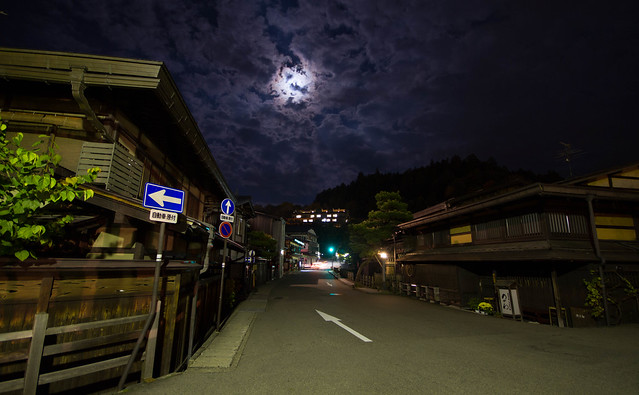
This one didn't quite fit the track -- since our character is on the train to begin with, demonstrating that peculiar Japanese skill of sleeping standing up holding on to the rings in the train and waking just at the right time for your stop -- but this image depicts the sameness, the regularity of the daily commute. For the character in Setsu I did want him to be like this on the surface but to have that private side that comes through by the time the first chorus kicks in: he's done his daily grind and he looks forward to the warm familiarity of his home. Stereo-typically salarymen are portrayed as being at work 90% of the time, drinking every night and sleeping it off in the gutter or in the train station; but I can't say I ever knew anyone like that. In Setsu, there is the sense that our our guy is sleep-walking through his day until he hears the train announcement that his stop is coming up, then he hits the streets on his bike and he's almost home, with the moon making her own nightly journey in the sky above him. (September is commonly the month for Tsukimi or 月見 -- or moon viewing.)

September was one of the months I really enjoyed in Japan: cooling down from the oppressive heat of summer, quite beautiful on a calm, moonlight evening. My own neighbourhood was only 15 minutes' ride from the centre of town but still had a few rice paddies (though I see from Google maps that the number has reduced since I left); but mostly the streets were typically close-ranked houses. At this time of year the windows would be open so you'd hear people splashing water over themselves to was off the soap before getting in the bath or you'd catch snatches of baseball commentaries -- and occasionally even see the middle-aged Giants fan himself sitting in his white singlet with a sweating can of Asahi Super Dry in his hand.

Still in Takayama

Thursday, September 17, 2015

My new album, Setsu / , is a tribute to Japan and the friends I made there.

Anyone who has lived in Japan any longer than a tourist will be bemused by Japanese friends' and co-workers' constant talk of the changing of the seasons (kisetsu / 季節), along with things that change with them: your wardrobe, the food you eat and, most importantly of course, the leaves. It's also the basis of about 50% of their English textbooks. "Japan has four seasons," I was proudly informed not long after arriving. I pointed out, mentally rolling my eyes, that there were four seasons where I came from too. It's an endearing habit of many Japanese that they kind of think they have a monopoly on lots of things, not just seasons, but skilful use of chopsticks, etc.

But after a while you come to realise that what they're saying is actually more profound: there is something fundamental to the way the year progresses that informs Japanese life and culture much more than where you come from. Sure you have brown and red leaves in autumn or blossoms in spring but they just do it more fully in Japan. And for the people there's a comfort and identity in these things, which are basically a by-product of how recently life there was still a feudal, agriculture-based existence.  

Setsu is an attempt to capture this spirit: twelve stories in twelve months told by twelve characters. The Chinese character Setsu / by itself means occasion or time, so fits the concept of the album perfectly. It can also mean verse, stanza or melody. And, yep, it's part of that word for season, kisetsu / 季節. The title track here, representing September, is emblematic in many ways. But more about that in another post.

I'll be releasing a track a month via Soundcloud and the whole album will be available via Bandcamp (when I finish it).

Wednesday, June 19, 2013

Summer Days


Wintry rain is lashing against the windows and the forecast is for blizzard-like conditions with gale force winds. Still, Summer Days was written about Japan rather than NZ, so late June is exactly the time to write this post. As a friend of mine said on Facebook the other day that rainy season was over, meaning that "swamp butt season" had arrived in Japan.  I leave you to reach your own conclusions about exactly he meant but let's just say that the heat and humidity makes it difficult to sit down for long periods.

As it turns out this is the track that receives the most plays on my bandcamp and soundcloud pages. And it is the only tune I chose to put on both my solo albums, so there must be something about it in my mind too. Actually I think of it as one of my simpler tunes, given that it's about, um, summer days. Like many of the other tunes on the Barry Starr concept album, the liner notes by his estranged vibraphonist (hey! - spell checker recognised that word) contain a lot of truth. The opening line - "come on down and sit around some" - was intended to evoke a sense of homely southern hospitality and the Maori-strum a sense of sitting around the barbecue with the acoustic, half-remembering the words to sing-along classics.

But the song is predominantly a homage to summer evenings hosted by our friend Jason, where we annoyed the honest folk in a quiet corner of our Japanese city by drinking and playing music into the wee hours. The garden we hung out in was probably about the size of two car parks, as evidenced by the little circle here.


Again, as suggested by Barry Starr's biographer, the middle ‘rap’ sequence is "made up of actual lines, debates and proclamations verbatim from the barbecues." But actually that's true of all the lyrics, which were inspired by the events of a time I remember with a lot of fondness. Debates about when the meat was cooked to prefection, people getting pissed (in both British and US senses of the term), people who were always really late, mostly because they were getting stoned, debates about whether REM were overrated and ghost stories - you name it. I am still incredulous that anyone could think Andie Macdowall was all that. Each to their own, of course. I particularly remember the ghost stories told by a Canadian guy with first nation ancestry about (if I recall correctly) things he saw the spirit of his grandmother doing in their house, like folding the washing. He was quite convincing and I really felt like he was telling the truth. He was also an alcoholic, of course.

PS The very observant will notice that the Barry Starr version is slightly faster than the Me for a Day Version, sped up by 8% to make it a little more pacey.

Friday, April 19, 2013

Who is Barry Starr?

Just who is Barry Starr? He is many things. Internet music pioneer, indie-rock idol, electro-pop studio recluse or sell-out Vegas crooner. Also, he is entirely fictitious.

Barry Starr is the eponymous protagonist of my new concept album, Best of Barry Starr: the part I played. Download the album from bandcamp and you also get an accompanying biography that takes the form of liner notes for each track, written by his vibraphone player (yes, his vibraphone player):
The myths, legends and apocryphal tales about Barry Starr are as numerous as the phases of his career: internet music pioneer, indie rock pin-up, electro-pop studio recluse, Vegas sellout. Did he sell out his first band (see notes to Track 4 )? Was the Vegas weight actually a fat suit (see notes to Track 12 )? Did he actually only exist in the mind of a record label publicity agent (see notes to Track 4 again). Those of us who knew him best have always known there were hints of truth in any of these stories but that the real story lurked somewhere in between and beyond.
The liner notes follow an arc through through Barry's career but also reveal as much about the biographer - and about me too in an exaggerated, fictionalised sense of course.

But more about that later... For now, check out the post on the opening track I like David Bowie or listen below to the song that changed the trajectory of Barry's career.