Labels

Showing posts with label bandcamp. Show all posts

Wednesday, January 13, 2016

Under the Kotatsu (こたつのしたに)


There was this Japanese teacher at my school, Shibata-sensei -- an understated, intellectual man with a quiet power about him. He was in his fifties but he was in excellent shape. I heard that each day he got up at 5am, walked up the mountain behind his house to the temple up there, practised his karate and then meditated, presumably silhouetted against the rising sun behind him. He also ran the Kendo club. He was big on the very traditional Japanese arts but also very modern in his attitudes.

He invited me round to his place one winter's night and we were served an impressive series of dishes, followed up by warm sake. He was something of a philosopher, being a practising Buddhist, and liked to discuss customs and beliefs in our respective countries. This particular night we were sitting under the kotatsu, that is a table with a quilt sitting underneath the table-top that you drape over your legs; underneath there is a little heater that creates a toasty-warm oven for your lower regions. It's, as far as I know, only in Japan that these are used. (In part this is simply a cheap solution to flimsy old-style Japanese houses with about as much insulation as a cardboard box.)
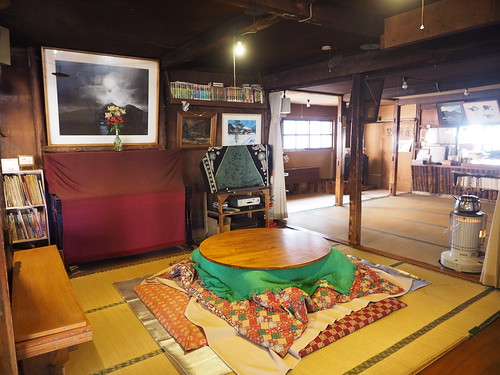
Kotatsu, Kuroyuri Hut Anyway, as we drank our sake he told us how he loved the Kotastu, for "the legs are warm but the head is clear." Classic Shibata.  The phrase always stuck with me and formed the basis for this song.

From the chorus (using the Roman alphabet):

Ashi ga atatakai, atatakai ga [My legs are warm, they're warm but]
Atama o sukkiri sasete kuru [my head is clear]
Boku wa ureshii, ureshii [I am happy, happy]
Kotastu no shita ni [under the kotatsu]

Saturday, January 9, 2016

Cosuplay musical notes

Cosuplay was the last tune to be completed for the Setsu album. It was quite a struggle to get the parts to fit together but, in the end, it's one of the tunes I'm most pleased with. For a while I wasn't sure if the juxtaposition between dark verse and poppy chorus worked: the verses alternate bars of B major then C major and the chorus shifts to a good old-fashioned doo-wop kind of thing with a G / E minor / A minor / C, though that does have an unexpected Gmaj7 thrown in on the word 'Geek'. Anyway, it was meant to sound both conformist and subversive to mimic the way the girls follow the rules all week and cosuplay on Sunday. Of course, this in itself is typical of Japanese subversion: it should still be done according to a strict schedule and within clearly-defined rules.

The dream sequence in the middle section, where the girls imagine leaving their "small town shopping mall" behind for the crowds and glamour of Harajuku, shifts unexpectedly from the neat resolution of the C at the end of the chorus up a semi-tone to a D flat minor. Again, this subversion of the doo-woppishness represents the rebelliousness of the thought of hanging out with 'actual' weirdos (what would grandma think!). To me at least, the girls in this tune won't realise this dream; the thrill is just in the thinking of it. Any kind of cosuplay I saw in Japan to me was all surface and no substance: kids didn't dress as punks in clothes they'd actually made look punky, it was all bought like that, pre-fabricated with rips and safety pins in place. It could just as easily have been teddy boy fashion or an anime character. They certainly didn't identify with the spirit of the punk movement.

The lyrics in the verses probably zip past too quickly to hear on a first listen (but they're on the Soundcloud page in the song info). The first part of the verse is solo voice only but then the backing vocals chime in, highlighted in this excerpt with all other tracks (except one guitar backing) switched off.

Saturday, December 19, 2015

Cosplay


The Japanese commitment to fashion is impressive. Whether it's middle-aged woman in a plain, Sunday kimono, a slicked-back silver-haired salary man in an immaculate grey blue suit or a teenage girl in Gothic Lolita outfit, each takes meticulous care to present their 'uniform' to society.

Uniforms of various sorts feature throughout the 12 months of the Setsu album: junior high kids and office ladies (On your bike, May); the salary man (Setsu, September); the Happi coats of the danjiri festival (Harvest, November); bleach-blonde, glitter-sparkles on a mascara-caked Yankie girl (Yankie girl, July); and most obviously here in December in Cosplay, with our protaganist, the Black Lolita, her friend Takako, White Lolita. As well, in the 'dream sequence' middle section, you've got Visual Kei, Ganguro and Punk kids hanging out in Harajuku.

This post on Japan Talk gives a pretty good overview (including some great photos) of the feeling a lot of westerners have when they get to Japan: everyone is wearing a uniform. It does miss a couple of my personal favourites however: the 'safety guy' at road works sites in faux 19th Century military uniform, complete with epaulets and hat, waving a glowing truncheon to ensure no-one falls into a cordoned-off ditch; and the construction workers with massively flared pants that must result in at least three construction deaths a year.

Cosuplay pays homage to the uniform spirit. The particular story I ended up with is two young girls who do the proper thing from Monday - Saturday at school but, despite the fact their local shotengai (shopping mall) is about as far from Harajuku as it gets, spend each Sunday dressing up and shocking the locals, no matter what the season.

Next post: musical notes on Cosuplay.

Wednesday, June 19, 2013

Summer Days


Wintry rain is lashing against the windows and the forecast is for blizzard-like conditions with gale force winds. Still, Summer Days was written about Japan rather than NZ, so late June is exactly the time to write this post. As a friend of mine said on Facebook the other day that rainy season was over, meaning that "swamp butt season" had arrived in Japan.  I leave you to reach your own conclusions about exactly he meant but let's just say that the heat and humidity makes it difficult to sit down for long periods.

As it turns out this is the track that receives the most plays on my bandcamp and soundcloud pages. And it is the only tune I chose to put on both my solo albums, so there must be something about it in my mind too. Actually I think of it as one of my simpler tunes, given that it's about, um, summer days. Like many of the other tunes on the Barry Starr concept album, the liner notes by his estranged vibraphonist (hey! - spell checker recognised that word) contain a lot of truth. The opening line - "come on down and sit around some" - was intended to evoke a sense of homely southern hospitality and the Maori-strum a sense of sitting around the barbecue with the acoustic, half-remembering the words to sing-along classics.

But the song is predominantly a homage to summer evenings hosted by our friend Jason, where we annoyed the honest folk in a quiet corner of our Japanese city by drinking and playing music into the wee hours. The garden we hung out in was probably about the size of two car parks, as evidenced by the little circle here.


Again, as suggested by Barry Starr's biographer, the middle ‘rap’ sequence is "made up of actual lines, debates and proclamations verbatim from the barbecues." But actually that's true of all the lyrics, which were inspired by the events of a time I remember with a lot of fondness. Debates about when the meat was cooked to prefection, people getting pissed (in both British and US senses of the term), people who were always really late, mostly because they were getting stoned, debates about whether REM were overrated and ghost stories - you name it. I am still incredulous that anyone could think Andie Macdowall was all that. Each to their own, of course. I particularly remember the ghost stories told by a Canadian guy with first nation ancestry about (if I recall correctly) things he saw the spirit of his grandmother doing in their house, like folding the washing. He was quite convincing and I really felt like he was telling the truth. He was also an alcoholic, of course.

PS The very observant will notice that the Barry Starr version is slightly faster than the Me for a Day Version, sped up by 8% to make it a little more pacey.

Friday, April 19, 2013

Who is Barry Starr?

Just who is Barry Starr? He is many things. Internet music pioneer, indie-rock idol, electro-pop studio recluse or sell-out Vegas crooner. Also, he is entirely fictitious.

Barry Starr is the eponymous protagonist of my new concept album, Best of Barry Starr: the part I played. Download the album from bandcamp and you also get an accompanying biography that takes the form of liner notes for each track, written by his vibraphone player (yes, his vibraphone player):
The myths, legends and apocryphal tales about Barry Starr are as numerous as the phases of his career: internet music pioneer, indie rock pin-up, electro-pop studio recluse, Vegas sellout. Did he sell out his first band (see notes to Track 4 )? Was the Vegas weight actually a fat suit (see notes to Track 12 )? Did he actually only exist in the mind of a record label publicity agent (see notes to Track 4 again). Those of us who knew him best have always known there were hints of truth in any of these stories but that the real story lurked somewhere in between and beyond.
The liner notes follow an arc through through Barry's career but also reveal as much about the biographer - and about me too in an exaggerated, fictionalised sense of course.

But more about that later... For now, check out the post on the opening track I like David Bowie or listen below to the song that changed the trajectory of Barry's career.