Labels

Saturday, February 20, 2016

Practice Perfect


I arrived in Japan and made my inaugural speech to the 1200 kids in my high school. This was in English so I kept things simple: I play the guitar; I like soccer. That sort of thing. Next day, to my surprise, the captain of the soccer club approached me and asked if I would come along to practice.

I went to my first one, after school on a blisteringly hot August afternoon. We did various drills, passing, dribbling, etc. This went on for about an hour-and-a-half. I, having come from a Southern Hemisphere winter, was thankful for the Mugi-cha that was on offer to quench the thirst. I was pretty buggered, frankly, but thanked them for the run out. The captain said they were only stopping for a break. Ah, really? I stuck it out in the heat and was pretty glad when we finished. When is the next practice, I inquired? Tomorrow. Every day, in fact. Wow, I said, you guys must have some big games coming up. Nope, no games, we just practice.

I didn't make it back for another practice.
Practise by George Alexander Ishida Newman (CC BY)

This tune celebrates the Japanese love of the familiar, of dedication and of the value in skill and art for it's own sake. I chose a potter as the central character in this particular story but it could have been any number of things: kids' relentlessly practising baseball or kendo or whatever; musicians, calligraphers, flower arrangers. Common to many of these pastimes or art forms, perfection is never attainable but something to be pursued.

Here I framed the theme in the broader context of traditional arts and the fear that these will be lost. The father is worried that his son (who is an oblique reference to the yet-to-be-released July track) won't carry on the art. But the traditional arts and strong and the Japanese will find a way...

Next post: it's many shades of brown, it's pottery, it's the local pottery!

Wednesday, January 13, 2016

Under the Kotatsu (こたつのしたに)


There was this Japanese teacher at my school, Shibata-sensei -- an understated, intellectual man with a quiet power about him. He was in his fifties but he was in excellent shape. I heard that each day he got up at 5am, walked up the mountain behind his house to the temple up there, practised his karate and then meditated, presumably silhouetted against the rising sun behind him. He also ran the Kendo club. He was big on the very traditional Japanese arts but also very modern in his attitudes.

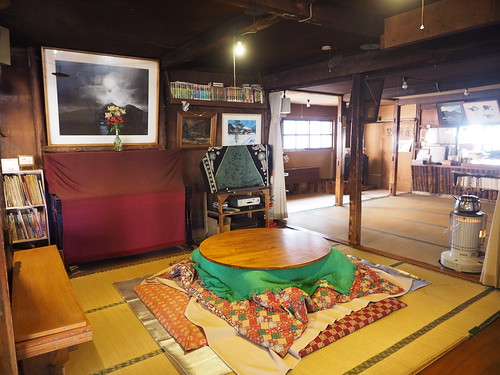
He invited me round to his place one winter's night and we were served an impressive series of dishes, followed up by warm sake. He was something of a philosopher, being a practising Buddhist, and liked to discuss customs and beliefs in our respective countries. This particular night we were sitting under the kotatsu, that is a table with a quilt sitting underneath the table-top that you drape over your legs; underneath there is a little heater that creates a toasty-warm oven for your lower regions. It's, as far as I know, only in Japan that these are used. (In part this is simply a cheap solution to flimsy old-style Japanese houses with about as much insulation as a cardboard box.)
Kotatsu, Kuroyuri Hut Anyway, as we drank our sake he told us how he loved the Kotastu, for "the legs are warm but the head is clear." Classic Shibata.  The phrase always stuck with me and formed the basis for this song.

From the chorus (using the Roman alphabet):

Ashi ga atatakai, atatakai ga [My legs are warm, they're warm but]
Atama o sukkiri sasete kuru [my head is clear]
Boku wa ureshii, ureshii [I am happy, happy]
Kotastu no shita ni [under the kotatsu]

Saturday, January 9, 2016

Cosuplay musical notes

Cosuplay was the last tune to be completed for the Setsu album. It was quite a struggle to get the parts to fit together but, in the end, it's one of the tunes I'm most pleased with. For a while I wasn't sure if the juxtaposition between dark verse and poppy chorus worked: the verses alternate bars of B major then C major and the chorus shifts to a good old-fashioned doo-wop kind of thing with a G / E minor / A minor / C, though that does have an unexpected Gmaj7 thrown in on the word 'Geek'. Anyway, it was meant to sound both conformist and subversive to mimic the way the girls follow the rules all week and cosuplay on Sunday. Of course, this in itself is typical of Japanese subversion: it should still be done according to a strict schedule and within clearly-defined rules.

The dream sequence in the middle section, where the girls imagine leaving their "small town shopping mall" behind for the crowds and glamour of Harajuku, shifts unexpectedly from the neat resolution of the C at the end of the chorus up a semi-tone to a D flat minor. Again, this subversion of the doo-woppishness represents the rebelliousness of the thought of hanging out with 'actual' weirdos (what would grandma think!). To me at least, the girls in this tune won't realise this dream; the thrill is just in the thinking of it. Any kind of cosuplay I saw in Japan to me was all surface and no substance: kids didn't dress as punks in clothes they'd actually made look punky, it was all bought like that, pre-fabricated with rips and safety pins in place. It could just as easily have been teddy boy fashion or an anime character. They certainly didn't identify with the spirit of the punk movement.

The lyrics in the verses probably zip past too quickly to hear on a first listen (but they're on the Soundcloud page in the song info). The first part of the verse is solo voice only but then the backing vocals chime in, highlighted in this excerpt with all other tracks (except one guitar backing) switched off.

Saturday, December 19, 2015

Cosplay


The Japanese commitment to fashion is impressive. Whether it's middle-aged woman in a plain, Sunday kimono, a slicked-back silver-haired salary man in an immaculate grey blue suit or a teenage girl in Gothic Lolita outfit, each takes meticulous care to present their 'uniform' to society.

Uniforms of various sorts feature throughout the 12 months of the Setsu album: junior high kids and office ladies (On your bike, May); the salary man (Setsu, September); the Happi coats of the danjiri festival (Harvest, November); bleach-blonde, glitter-sparkles on a mascara-caked Yankie girl (Yankie girl, July); and most obviously here in December in Cosplay, with our protaganist, the Black Lolita, her friend Takako, White Lolita. As well, in the 'dream sequence' middle section, you've got Visual Kei, Ganguro and Punk kids hanging out in Harajuku.

This post on Japan Talk gives a pretty good overview (including some great photos) of the feeling a lot of westerners have when they get to Japan: everyone is wearing a uniform. It does miss a couple of my personal favourites however: the 'safety guy' at road works sites in faux 19th Century military uniform, complete with epaulets and hat, waving a glowing truncheon to ensure no-one falls into a cordoned-off ditch; and the construction workers with massively flared pants that must result in at least three construction deaths a year.

Cosuplay pays homage to the uniform spirit. The particular story I ended up with is two young girls who do the proper thing from Monday - Saturday at school but, despite the fact their local shotengai (shopping mall) is about as far from Harajuku as it gets, spend each Sunday dressing up and shocking the locals, no matter what the season.

Next post: musical notes on Cosuplay.

Friday, November 27, 2015

Harvest musical notes

Harvest starts out with chanting, drums, bells and calls from a danjiri festival, though not acually the Katsuyama 'quarrelling' shrines that inspired the tune. It took a while but I found chanting that matched the tempo of the tune, which I wanted to pulse along in the rhythm created by the crowd - hence a strong hi-hat on the quarter beats rather than my more typical eighth notes in a tune that's reasonably slow (87 bpm to be precise).

Similarly, the chanting lyrics when my vocals come in are meant to be crowd-like, then the call-and-answer style of the verses matching the danjiri festivals, where certain individuals lead the calls of their group. I had this group ethic in mind with the repeated phrases echoing each other in the outro too, which were pretty much just improvised as the recording kept going and then edited into some semblance of cohesion.

I had originally thought this tune might be all-acoustic, including all the percussion being shakers, tambourines and such. Then I jammed the bass line, which is fairly stomping if I say so myself, and couldn't go back. Kickin' drum sounds just had to go with it. The solo guitar parts, though, are a nod to this original idea, with the Mermaid Guitar itself brought into the action. It's not the easiest guitar to solo on, at least in the bluesy style of this song, having a high action to the fret-board. Worked out pretty well. The rhythm guitar parts are my Takamine and the Mermaid, each part panned hard to one side of the stereo image.

After several takes my voice was pretty shredded but I kept a lot of those later takes as the final version, a la John Lennon on Twist and Shout - nice inappropriate comparison there. Perhaps the episode of Friends where Phoebe has a cold is a better one.

Tuesday, November 24, 2015

The quarelling shrines


The insane custom that is the Katsuyama 'quarrelling' danjiri festival (勝山喧嘩だんじり) was one of the outstanding cultural experiences of my life in Japan. Danjiri - portable shrines dressed up to look like carts-cum-boats with branches attached - are pulled by liquored-up townsfolk in a sort of destruction derby crossed with tug of war. Just watch a bit of the video.


No surprise that one of the locals we knew told us that her husband had lost a finger, the chances of which seem pretty high even without the amount of sake and beer that is consumed in the hours proceeding the evening of the actual festivities.

The video doesn't really do the atmosphere justice. Banks of spectators crammed on either side of the street in a beautifully preserved historical precinct; chanting participants (Oii-saaa! Oii-saaa!); constant clanging of the 'shrine' bells inside the danjiri and beating of drums. Then the two danjiri are propelled by each team in a mad rush and - smack! Typically for this kind of thing, no-one really seems to care who wins. 

This was the inspiration for the November track for my album Sestu (though I know the actual event, as in the video title above, is held in October. More on the tune itself in the next post.

Friday, November 13, 2015

Musical notes on Haiku Part 2

I agonised over the transition between the folksy acoustic (as described in part 1 of these musical notes) and the rocky parts of the tune. The simple, acoustic layers were always to be set against the dry, harsh boppiness of the electric segment. The idea was to represent the two sides of the changing seasons in Japan: a quiet contemplation of the transience of nature with its melancholy reminder of our own temporary existence as opposed to the rushed, obligation of modern social mores.

In the end for the transition out of the acoustic into the electric I went with a short solo blast of the bass line that pumps along throughout.


I'm actually playing my bass here (in other words it's not a sample or anything) but with a sequencer effect on it, the kind usually used for keyboards, which gives it that pulsing effect.
Ant-lines on the highway, marching along to the rhythm...
The waveform inside Sonar (the program I use to record and mix) makes this plain, the regular blobs of the top one with the effect on and the screen grab under it with the effect off.


I rarely put effects on my bass lines but it seemed to fit here, since this section was meant to sound 'metropolitan.'

As for the rest of the tune, I took the sound of The Strokes Is this it? as a template: crunchy, slightly distorted drum sound; two guitars, one on either side of the stereo spectrum, playing Strokes-like riffs; the whole tune is short and punchy. In earlier mixes I had a distortion effect on the vocals too, a signature of the Is this it? sound, but in the end I just didn't like it, especially with the rich harmonies in the haiku that forms the start of the second verse:
Melancholy I
Gaze upon soon gone mellow,
Red-yellow colours 
Lyrically, I wanted it to be prosaic to emphasise the lack of spirituality in the mechanical annual trek to hunt red leaves: how many songs have lyrics about uploading pictures to your desktop or buying omiyage?

The 'winding down' effect was the last thing I settled on with this track, as the rocky section reverts to the folk ending. It's achieved with a very basic sampling tool built into Sonar called Alias Factor, on a setting called 'Wooly Mammoth,' which appealed. Basically I faded out the guitars gradually, leaving the pulsing bass from the beginning higher in the mix, while applying this sampler to the drum track. Basically it down-samples the sound it receives into a more and more basic digital quality level so that by the end it sounds like a sound effect in a retro computer game.

This post is another in a series on my album Setsu, 12 songs in 12 months to celebrate life in Japan.